
- HOME
- Sustainability
- Governance Initiatives (G)
Governance Initiatives (G)
(1) Compliance /Risk Management
● Corporate Governance
Directors’ Compensation
The payment criteria and timing for the compensation of the Executive Director and Supervisory Directors of FRC are as follows.
- The fee for the executive director shall be paid by the last business day of each month in an amount determined by the Board of Directors up to 1 million yen per month.
- The fee for each supervisory director shall be paid by the last business day of each month in an amount determined by the Board of Directors up to 0.3 million yen per month.
Director's Overview
| Position | Name | Principal Concurrent Positions | Reason for Appointment | Total fee for each for the 43rd fiscal period (thousands of yen) |
|---|---|---|---|---|
| Executive Director | Yukitaka Ohara | Fukuoka Realty Co., Ltd. President and CEO |
Extensive knowledge and experience in real estate investment management and real estate business. | - |
| Supervisory Director | Takashi Tanabe | Representative Attorney, Tanabe Law Office | Extensive knowledge and experience as an attorney in corporate law, real estate-related law, compliance, and risk management. | 1,800 |
| Supervisory Director | Masahiro Uchida | Representative Certified Public Tax Accountant, Masahiro Uchida Tax Accountant Office | Extensive knowledge and experience in taxation, accounting, internal control, and risk management, in addition to expertise as a certified public tax accountant. |
● Compliance/Ethical Standards
1. Policies for Customer-Oriented Business Operations
Fukuoka Realty Co., Ltd., has formulated Policies for Customer-Oriented Business Operations on September 20, 2017. Please check here for details.
Fukuoka Realty Co., Ltd.
(Policies for Customer-Oriented Business Operations)
2. Strengthen Decision-Making Process
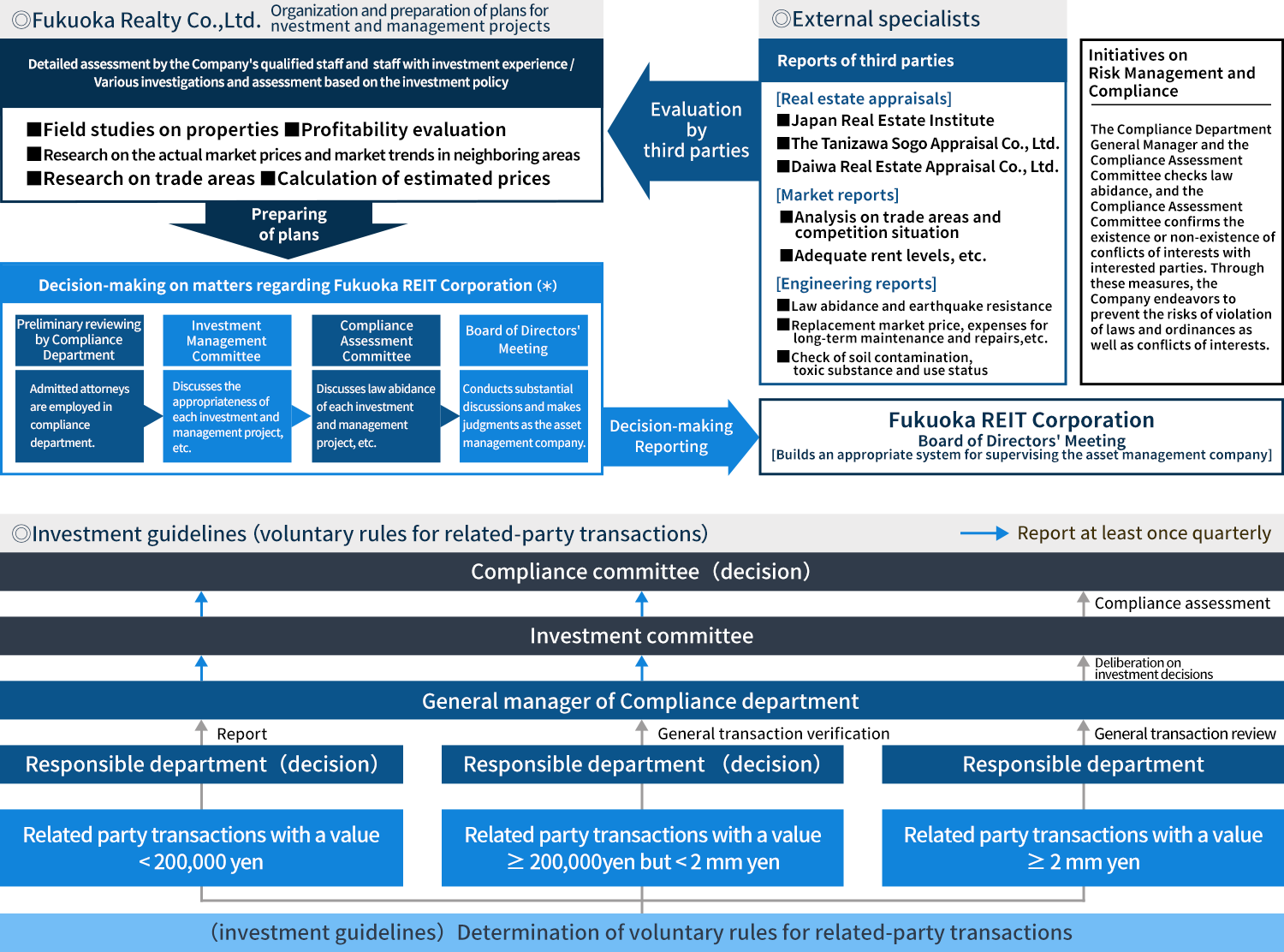
- Expenditures for construction costs, property surveys, inspections, and similar items ¥2,000,000 or more and less than ¥5,000,000: Requires approval by the Executive Officer of the Asset Management Company ¥5,000,000 or more and less than ¥10,000,000: Requires approval by the President
- Transactions other than those covered under (*1) above
3. Reporting and Consultation for Employees (Compliance Helpline)
The Asset Management Company has established a Compliance Helpline (hereinafter referred to as the "Helpline") as a contact point where all employees (including secondees, contract employees, and part-time employees) can report or consult on compliance-related matters, including not only violations of laws and regulations but also fraud and corruption, human rights violations, and other issues of corporate ethics.
The Helpline is administered by the Compliance Officer; where the Compliance Officer has a conflict of interest in the matter, responsibility is assumed by the President and CEO. Furthermore, in accordance with the Fundamental Compliance Policy and Rules of Employment, any detrimental treatment or retaliation against individuals who submit reports or requests for consultation, or who cooperate with investigations, is strictly prohibited. The Compliance Department rigorously safeguards the privacy of the individuals concerned and maintains an environment in which reports and consultations can be submitted with confidence.
Important matters among the reports and consultations received through the Helpline are reported to the Board of Directors, and matters related to the asset management of the Investment Corporation are reported to both the Board of Directors and the Board of Directors of the Investment Corporation.
The Helpline is communicated by the Compliance Department through orientation training for new employees.
4. Response to Anti-Social Forces
The Asset Management Company positions compliance, including corporate ethics, as one of its key management priorities and maintains a resolute policy of refusing any and all dealings with anti-social forces. Under this policy, based on the intent of the "Guidelines for Preventing Damage from Anti-Social Forces" (government policy), the "Comprehensive Guidelines for Supervision of Financial Instruments Business Operators," and the "Fukuoka Prefecture Ordinance for the Elimination of Organized Crime Groups," the Asset Management Company has established the "Regulations for Response to Anti-Social Forces" with the approval of the Board of Directors, along with the "Procedures for Response to Anti-Social Forces" as specific operational standards.
The "Regulations for Response to Anti-Social Forces" establishes the fundamental policy for the elimination of anti-social forces and the management structure for its implementation to achieve company-wide compliance, while the "Procedures for Response to Anti-Social Forces" specifically sets forth verification procedures when the Asset Management Company or the Investment Corporation initiates transactions with third parties, responses when a business partner is found to be an anti-social force, and responses when unreasonable demands are received. Through these measures, we aim to establish an effective management structure for the elimination of anti-social forces and ensure its appropriate operation.
5. Measures Against Money Laundering and Terrorist Financing
The Asset Management Company recognizes that the prevention of money laundering and terrorist financing (Anti-Money Laundering / Countering the Financing of Terrorism, hereinafter referred to as "AML/CFT") is a critical obligation expected by the international community. To prevent customers and employees from being involved in money laundering and terrorist financing, the Company has established a fundamental policy based on the "Guidelines for Anti-Money Laundering and Countering the Financing of Terrorism" published by the Financial Services Agency (Basic Regulations for AML/CFT Management).
In accordance with the "AML/CFT Management Procedures" and "AML/CFT Risk Assessment Implementation Procedures" established under these regulations, the Asset Management Company identifies and evaluates the risks it faces in a timely and appropriate manner, implements risk-proportionate mitigation measures, and has established an AML/CFT framework based on this approach to ensure appropriate operations.
6. Prevention of Fraud and Corruption
The Asset Management Company recognizes that preventing fraud and corruption through practicing compliance, including adherence to ethics and laws, and building a fair workplace and sound business relationships is its corporate social responsibility and public mission, and has established the “Fundamental Compliance Policy.” This policy establishes the following measures for preventing bribery and corruption applicable to all officers and employees, striving to prevent fraud.
- Prohibition of Bribery of Public Officials: Employees are prohibited from providing, directly or through third parties, illegal or excessive entertainment, favors, or other benefits (including the provision, offer, or promise of money or other benefits) to public officials and deemed public officials (including private enterprises subject to bribery regulations under domestic and foreign laws). Even where no law or regulation is violated, entertainment that would appear inappropriate in light of the public official‘s position or authority is prohibited.
- Prohibition of Accepting Bribes: Even with persons other than public officials, regardless of whether there is a direct business relationship, gifts or entertainment exceeding the bounds of common sense is prohibited. If an employee unintentionally becomes involved in a situation that could be considered problematic, the employee must report the facts to the Compliance Department and follow the instructions provided.
- Prohibition of Requesting Kickbacks and Other Benefits: Employees must not use their position to request money, goods, or entertainment from business partners, even in indirect terms. If an offer of benefits is received in connection with a business partner relationship , the employee must report the facts to the immediate supervisor or the Compliance Department and follow the instructions provided.
Regarding these efforts to prevent fraud and corruption, we ensure thorough dissemination of compliance requirements and its purpose to all employees through regular compliance training, further requiring all employees to submit an annual pledge stating compliance with the Fundamental Compliance Policy. We also verify effectiveness through annual internal audits and work to prevent fraudulent activities, achieve early detection and correction of issues.
Furthermore, violations of laws and the Fundamental Compliance Policy will be dealt with strictly in accordance with relevant laws and internal regulations. Since the commencement of operations of the Investment Corporation, there have been no fines or penalties applied in relation to fraud and corruption.
7. Oversight by the Board of Directors
The Asset Management Company recognizes that compliance, which includes not only adherence to laws and regulations but also the practice of fair and honest business activities based on high ethical standards, is its corporate social responsibility and public mission.
Based on this recognition, the Board of Directors has established the "Compliance Regulations" with the aim of fostering company-wide compliance awareness and continuous improvement, along with the "Fundamental Compliance Policy" as practical guidelines. This policy is reviewed annually to ensure its effectiveness in light of changes in social conditions and legal regulations.
Furthermore, the Board of Directors formulates an annual "Compliance Program" with the aim of improving the effectiveness of the compliance framework and promotes its consistent execution. The formulation of these "Compliance Regulations" and "Compliance Program" is approved by the Compliance Committee, which consists of the General Manager of the Compliance Department and two or more independent external experts, prior to finalization by the Board of Directors, thereby ensuring high objectivity and effectiveness.
The program's implementation status and evaluation results are reported regularly to the Board of Directors and the Compliance Committee, whose oversight and verification drive continuous improvement of the compliance framework.
In addition, to systematically manage and control incidents including legal violations and administrative errors, the Asset Management Company has established the “Regulations for Handling Incidents” and “Procedures for Handling Incidents,” which set out the specific operational steps. Approved by the Board of Directors, these rules together ensure consistent management of each case, from the initial report through to recurrence prevention and follow-up monitoring. A reporting structure has been established to report the occurrence of incidents and the results of responses to the Compliance Committee, the Board of Directors, and the Board of Directors of the Investment Corporation (limited to incidents related to investment management operations).
8. Implementation of Regular Internal Audits
The Asset Management Company has established the Internal Audit Regulations and the Internal Audit Guidelines that set forth specific implementation procedures (collectively referred to as the "Internal Audit Regulations, etc."), and by clearly specifying a series of procedures for the internal audit structure, audit procedures, reporting, recurrence prevention, and follow-up, it ensures a system for conducting organized and effective internal audits.
Internal audits are conducted by the Internal Audit Office within the Compliance Department (audits of the Compliance Department are conducted by the Planning Department from the perspective of ensuring independence), and are performed annually covering all departments. The audits review and evaluate the management and operational systems related to all business activities and the status of business execution from the perspectives of legality and rationality, including the perspectives of fraud and corruption prevention and corporate ethics, and based on the audit results, provide necessary information, improvement proposals and recommendations, and advice toward operational rationalization to the audited departments.
In addition, internal audits are conducted based on a risk-based approach, and an annual internal audit plan is formulated each year with the approval of the Board of Directors, appropriately reflecting the results of company-wide risk assessments and significant internal and external environmental changes surrounding the business. In addition to audit results, important matters regarding the status of corrective measures in each department are also reported to the Board of Directors, establishing a system to improve business activities under the proactive involvement of the Board of Directors.
Furthermore, in conducting audits, we draw on the support of external experts to ensure expertise and objectivity, while continuously strengthening our internal controls and our systems for preventing fraud and corruption.
9. Framework for Sustaining Employee Engagement (Ongoing Education and Training)
The Asset Management Company strives to enhance internal education and training so that each employee recognizes it as their duty to always pursue the best interests of unitholders and can make independent judgments and take actions based on high ethical standards and expertise.
Specifically, we conduct regular and ongoing training on sustainability and compliance that includes the practice of corporate ethics for all officials and employees (including secondees, contract employees, and part-time employees) to improve knowledge and foster awareness.
Through these initiatives, we ensure fairness in our operations and the appropriate management of conflict-of-interest transactions. At the same time, we foster a sound corporate culture that does not tolerate fraud or corruption, encouraging each employee to raise their ethical awareness and take an active role in improving the workplace and preventing misconduct.
| (No. of sessions) | Oct. 2022 ~ Sep. 2023 | Oct. 2023 ~ Sep. 2024 | Oct. 2024 ~ Sep. 2025 |
|---|---|---|---|
| ■ Corporate Ethics・Compliance training (including e-learning) | 7 | 5 | 7 |
| ■ Sustainability training | 4 | 4 | 4 |
Programs Available to All Employees (Including Contract and Part-Time Employees) (FY2025 Results)
| ■ Corporate Ethics・Compliance Training | ■ Sustainability Training |
|---|---|
| Training on Appropriate Response to Financial Regulations and Improving Communication Skills | PVMV Workshop |
| Insider Trading Regulations | Greenhouse Gas Calculation and Reduction |
| AML/CFT (Money Laundering, etc.) Response | Climate Change Risks and Responses |
| Managing Risks Related to Antisocial Forces | Diversity and Inclusion |
| Incidents at Asset Management Companies | Environmental Performance Data |
| Cybersecurity Awareness | Integrated Report Training |
(2) Dialogue with Stakeholders
The Asset Management Company holds financial results briefings for analysts and institutional investors at the end of each fiscal period of FRC, where representative directors and executives provide earnings reports and business overviews. Additionally, briefing materials are promptly published on our website to ensure fair and timely information disclosure.
Furthermore, we conduct IR activities targeting institutional investors both in Japan and overseas.
For our individual investors, we communicate the appeal of our region-specific REIT and our sustainability initiatives in an easy-to-understand manner through in-person and online seminars as well as through web content.
■ IR Activities of Fukuoka REIT Corporation
| (No. of sessions) | Sep. 2022 ~ Aug. 2023 | Sep. 2023 ~ Aug. 2024 | Sep. 2024 ~ Aug. 2025 | ||
|---|---|---|---|---|---|
| Financial results briefing | 2 | 2 | 2 | ||
| Domestic (Japan) IR (*1) | 171 | 179 | 171 | ||
| Overseas IR (*1) | 40 | 28 | 29 | ||
| IR for individual investors (*2) | 6 | 10 | 8 |
- including conference calls
- including financial results briefings to individual investors